
The most financially prominent American pastors have estimated net worths ranging from roughly $1 million to well over $100 million, built through a mix of book royalties, speaking fees, media rights, real estate holdings, and, in some cases, for-profit business ventures that operate alongside their ministries. Joel Osteen is consistently cited at $50–$100 million, T.D. Jakes at $20–$30 million, Joyce Meyer at around $8–$10 million (with a board-disclosed 2022 salary of $296,154), and Steven Furtick at $8–$10 million. These are estimates, not audited totals, and the transparency of supporting documentation varies enormously from one pastor to the next.
American Pastors Net Worth: Estimates, Sources & Profiles

Marcus Henley
12 Aug 2026
What this article covers and our editorial stance
This article compiles sourced, conservative net worth estimates for notable American pastors using the same methodology we apply across all profiles on this site: public filings, property records, disclosed compensation, verifiable book and media income, and credible business reporting. We do not publish rumor-based figures, and we flag explicitly when an estimate relies on limited disclosure. The goal is reference-quality data that a journalist, researcher, or curious reader can actually use, not a ranking designed to sensationalize pastoral wealth. Where the evidence is thin, we say so. Where income streams are unusually well-documented, we walk through exactly why.
Key takeaways before you dive in
- Most U.S. churches are legally exempt from filing Form 990, so direct salary disclosure is rare; estimates depend on cross-referencing real estate, book deals, speaking fees, and media income.
- When a pastor leads a public charity (not a church) that does file Form 990, compensation appears on Schedule J — this is the most reliable single data point we have.
- Book royalties can be substantial: a bestselling title with 1–2 million copies sold at a typical 10–15% hardcover royalty can generate $3–$8 million in lifetime author income from one book alone.
- Real estate is often the largest single asset — parcel searches via county appraisal district databases (e.g., Harris County Appraisal District for Houston-area pastors) provide assessed values and ownership confirmation.
- All figures in this article are estimates presented as ranges, not verified personal financial statements. Net worth can shift significantly with real estate markets, book-sales cycles, and ministry organizational changes.
- International figures (such as Pastor Godman Akinlabi, based in Nigeria) are noted separately because U.S. public records tools do not apply, and disclosure norms differ substantially.
- Some names that surface in reader searches — Art Pope, The Revivalists — are not pastors; we explain the context and handle them accordingly.
Leading U.S. pastors, estimated net worths at a glance
| Name | Estimated Net Worth (Range) | Primary Income Sources | Profile Status |
|---|---|---|---|
| Joel Osteen | $50M – $100M | Books, TV/media rights, speaking fees, real estate, Lakewood Church salary | Full profile on site |
| T.D. Jakes | $20M – $30M | Books, films, conferences, real estate, T.D. Jakes Enterprises | Full profile on site |
| Joyce Meyer | $8M – $10M | Books, Joyce Meyer Ministries salary ($296K disclosed, 2022), TV, conferences | Full profile on site |
| Steven Furtick | $8M – $10M | Books, Elevation Church salary, music/worship albums, speaking | Full profile on site |
| Greg Laurie | $5M – $10M | Harvest Ministries, books, Harvest Crusades, radio/TV | Full profile on site |
| Paula White | $5M – $10M | Books, speaking fees, City of Destiny Church, TV ministry | Full profile on site |
| Francis Chan | $1M – $3M | Books (notably 'Crazy Love'), speaking fees; known for significant charitable giving | Full profile on site |
| Andy Priest (Houston) | Under review | Real estate ministry context; limited public disclosure | Research in progress |
| Pastor Ashley Wooldridge | Under review | Christ Church of the Valley salary; limited public 990 disclosure | Research in progress |
Image suggestions
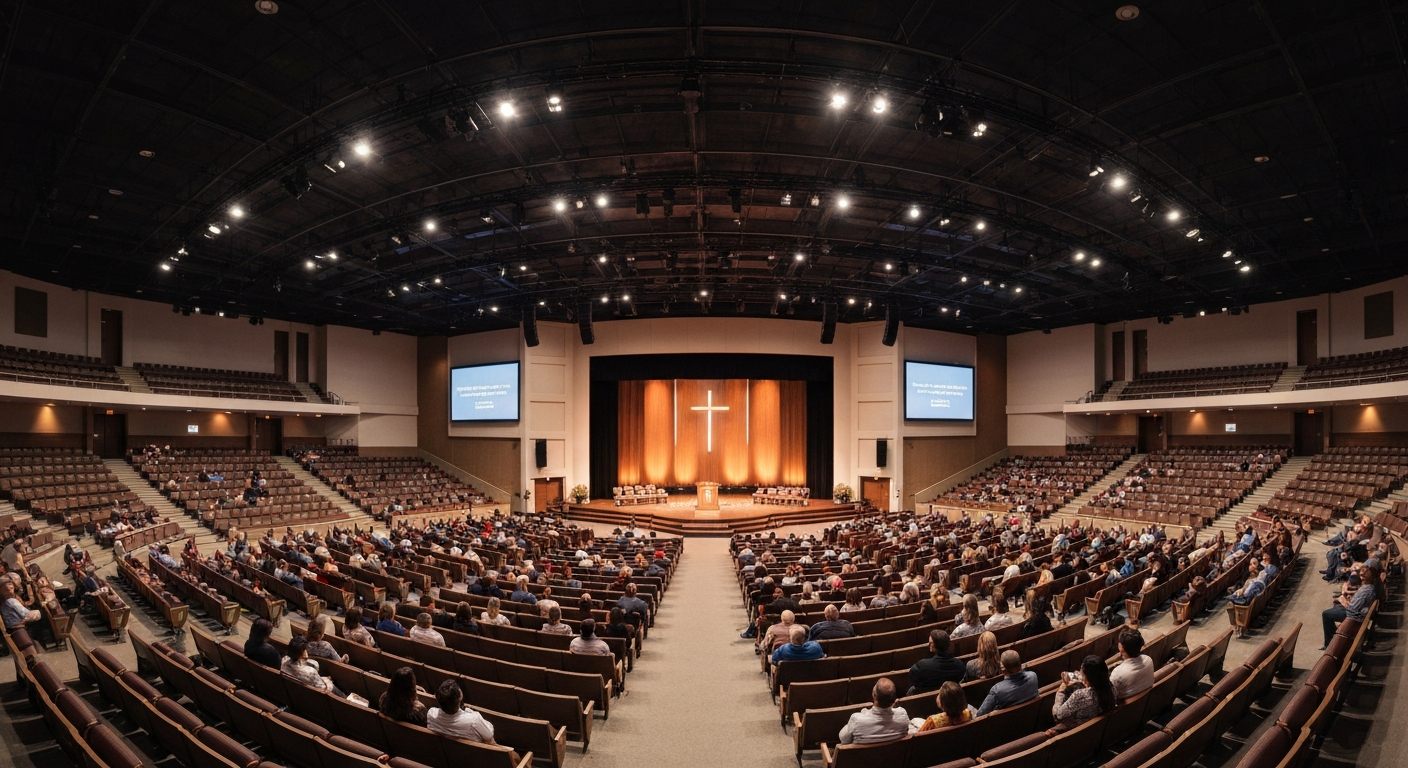
- Hero image: A wide-angle aerial or interior shot of a large American megachurch auditorium (such as a stadium-style worship venue) with the congregation seated — conveys scale without singling out one individual. Caption suggestion: 'Megachurch ministry in the U.S. generates revenue streams that include broadcasting, publishing, and live events — all of which factor into net worth estimates for lead pastors.'
- Profile headshots: Use licensed press photos or official church/ministry headshots for each pastor. Avoid tabloid-style paparazzi images. Caption format: '[Name], lead pastor of [Church/Ministry] — estimated net worth $X–$Y million as of [year].'
- Infographic suggestion: A horizontal bar chart titled 'Estimated Net Worth Ranges: Notable U.S. Pastors (2025–2026)' showing each pastor's range on a single axis, with a note that all values are estimates. This makes the table data scannable at a glance.
- Data graphic: A stacked icon chart breaking down the typical income-stream mix for a high-profile pastor (e.g., books 35%, speaking 25%, media/TV 20%, real estate 15%, salary 5%) to help readers visualize how wealth accumulates.
Notable pastor profiles
Joel Osteen, estimated $50M to $100M
Joel Osteen is the senior pastor of Lakewood Church in Houston, Texas, which occupies the former Compaq Center under a 30-year municipal lease. Public reporting at the time of the 2005 building conversion documented lease and renovation costs in the range of $75–$95 million for the facility. Osteen has stated publicly that he stopped drawing a Lakewood salary after his first book, 'Your Best Life Now' (2004), became a runaway bestseller. That book and subsequent titles (including 'Become a Better You' and 'The Power of I Am') have collectively sold tens of millions of copies. At standard hardcover royalty rates, even conservative unit-sales estimates place his lifetime author income well into the tens of millions. His River Oaks-area residential property in Houston has been reported and can be partially verified through Harris County Appraisal District records. Because Lakewood Church is a church (not a public charity required to file Form 990), direct salary disclosures are not available from IRS public records. The $50–$100 million range reflects wide honest uncertainty, the lower end assumes modest real estate and investment accumulation; the upper end incorporates reported property values and peak book-income estimates.
T.D. Jakes, estimated $20M to $30M
Bishop T.D. Jakes leads The Potter's House in Dallas, a congregation with roughly 30,000 members. His wealth is unusually diversified for a pastor: T.D. Jakes Enterprises (a for-profit entity) manages film production (the 'Woman Thou Art Loosed' franchise), music, conferences, and publishing. His books, including 'Woman Thou Art Loosed' and 'Destiny,' have sold millions of copies. Texas Secretary of State business entity search records can confirm the registration history of Jakes-affiliated for-profit entities, which is the key step in separating his personal commercial income from church ministry operations. The $20–$30 million range is based on cross-referencing reported book income, film production revenue, conference business scale, and Dallas-area real estate holdings reported in credible business journalism.
Joyce Meyer, estimated $8M to $10M
Joyce Meyer's net worth is one of the better-documented among high-profile pastors because Joyce Meyer Ministries files Form 990 (it operates as a public charity, not a church) and publishes an annual report. The 2022 Annual Report (Grace & Mercy) discloses a board-approved compensation of $296,154 in salary and fringe benefits for Meyer that year. Her more than 100 published books, many of them bestsellers, represent a substantial royalty stream that has compounded over decades. She has also faced past scrutiny regarding ministry-purchased real estate, which led to increased disclosure practices. When 990 filings are combined with book-sales history and speaking-fee norms for figures of her profile, the $8–$10 million range is a defensible conservative estimate. Anyone researching Meyer's finances should start with ProPublica's Nonprofit Explorer, which aggregates Joyce Meyer Ministries 990 data and extracts executive compensation lines.
Steven Furtick, estimated $8M to $10M
Steven Furtick founded Elevation Church in Charlotte, North Carolina, which has grown into one of the largest churches in the U.S. by attendance. Elevation Church is organized as a church and is therefore not required to file Form 990, making salary verification through IRS records impossible. Furtick's net worth estimate is driven primarily by his book royalties (titles such as 'Sun Stand Still,' 'Crash the Chatterbox,' and 'Greater' have reached the New York Times bestseller list) and by music revenue from Elevation Worship, one of the most-streamed worship music brands in contemporary Christian music. He and his wife Holly drew attention around 2013–2014 when local reporting documented the construction of a large custom home in Waxhaw, North Carolina. Mecklenburg County property records are the appropriate verification tool for that asset. The $8–$10 million range is consistent with documented publishing income and reported property values.
Greg Laurie, estimated $5M to $10M
Greg Laurie is the senior pastor of Harvest Christian Fellowship in Riverside, California, and the founder of Harvest Crusades, an evangelistic organization that has drawn stadium-sized crowds for decades. His income streams include books, radio and TV broadcasting via 'A New Beginning,' and speaking engagements. The 2023 biopic 'Jesus Revolution,' based in part on Laurie's conversion story and produced with Lionsgate, gave his public profile a significant boost. Harvest Ministries files Form 990, so compensation data is accessible through ProPublica's Nonprofit Explorer or Candid's 990 archive. California also requires charities soliciting in the state to register with the California Attorney General's Registry of Charitable Trusts, providing a secondary disclosure pathway. His range reflects documented ministry compensation supplemented by book and media income.
Francis Chan, estimated $1M to $3M
Francis Chan is one of the more unusual cases in this group: his 2008 book 'Crazy Love' sold over 1 million copies and generated royalties that, by his own public account, he donated entirely to charity. Chan has spoken openly about giving away most of his income and downsizing significantly. He resigned from Cornerstone Community Church in Simi Valley, California, in 2010 and has since operated in a more itinerant and international ministry context. His estimated net worth is therefore among the lowest in this group, not because his income potential is low but because his stated and documented giving pattern compresses personal asset accumulation. This is an important distinction: income and net worth are not the same thing, and Chan's case illustrates why.
Paula White, estimated $5M to $10M
Paula White is the senior pastor of City of Destiny in Apopka, Florida, and came to broader public attention through her role as a spiritual adviser to former President Donald Trump's first administration. Her income streams include books, speaking fees, TV ministry, and ministry donations. Without consistent Form 990 filings for her primary church entity, verification relies on book-sales history, property records in the Orlando metropolitan area, and credible political and religion journalism. The $5–$10 million range is consistent with those sources, though the upper end carries more uncertainty.
Select megachurch lead pastors worth monitoring
Beyond the profiles above, several other megachurch lead pastors generate significant research interest. Rick Warren (Saddleback Church, now stepped back from lead pastor role) is notable for publicly reverse-tithing, giving 90% and living on 10%, and has documented the buyback of his book royalties from his publisher. Andy Stanley (North Point Ministries, Alpharetta, Georgia) leads one of the largest church networks in the country; North Point files Form 990 as a supporting organization, giving researchers access to some compensation data. Craig Groeschel (Life.Church, based in Edmond, Oklahoma) leads the church with arguably the widest digital reach in America; Life.Church is a church entity, so 990 data is limited, but its YouVersion Bible App is a significant for-profit-adjacent asset. Each of these pastors has a distinct income profile that warrants individual examination rather than group generalization.
Profiles from reader queries and sibling topics
Andy Priest (Houston), research pointers
Andy Priest is a Houston-area figure who surfaces in reader searches in a real estate and ministry context. At the time of publication, there is insufficient public documentation to produce a verified net worth estimate. Research pathways include Harris County Appraisal District property searches, Texas Secretary of State business entity filings, and any Form 990 filings associated with affiliated nonprofit entities searchable via ProPublica or the IRS TEOS portal. A dedicated profile page is in progress on this site.
Pastor Ashley Wooldridge, status and verification
Pastor Ashley Wooldridge is the lead pastor of Christ Church of the Valley (CCV) in Peoria, Arizona, one of the largest churches in the Southwest by attendance. CCV is a church entity, so Form 990 filings are not required and are not publicly available. Verification of Wooldridge's compensation requires alternative pathways: Maricopa County Assessor property records for residential and ministry-adjacent real estate, Arizona Secretary of State business filings for any for-profit entities, and any voluntary financial disclosures published by CCV. Until those records yield a reliable compensation anchor, we are not publishing a point estimate. A dedicated profile is being assembled and will reflect only what the records support.
Pastor Godman Akinlabi, a note on international figures
Pastor Godman Akinlabi leads The Elevation Church in Lagos, Nigeria, one of the more prominent contemporary churches in West Africa. Because he is not a U.S.-based public figure, the entire toolkit of U.S. public records, IRS Form 990, EDGAR, county appraisal districts, state charity registries, does not apply. Nigerian corporate registry records, local business journalism, and the church's own voluntary financial disclosures are the appropriate starting points, but disclosure norms in Nigeria differ substantially from U.S. standards, and reliable third-party verification is significantly harder to obtain. We handle international figures by being explicit about these limitations rather than publishing a speculative number dressed up as a researched estimate.
Art Pope, clarification: business and political figure, not a pastor
Art Pope is a North Carolina businessman, political donor, and former state budget director, best known as the chairman of Variety Wholesalers. He is not a pastor or religious leader. He appears in this silo likely because of keyword co-occurrence in searches about religious and political influence. His net worth profile belongs in our business and politics coverage, and his dedicated profile on this site covers his commercial and civic activities in full. We include this note because conflating business figures with clergy in wealth coverage is a common research error worth correcting explicitly.
The Revivalists, band, not a church
The Revivalists are a New Orleans-based rock and soul band, not a church or ministry group. Their name generates crossover searches in religious content. Their net worth profile on this site covers the band as a collective music entity, examining touring revenue, streaming income, and record deals, standard musician net worth methodology. For detailed figures, see our page on the Revivalists' net worth, which examines the band's combined touring, streaming, and record-deal income the revivalists net worth. For collective entities, we estimate the group's combined earnings and note where individual member splits are undisclosed.
Meat Church, ASAP Preach, and Richard Asprey, handling uncertainty
These three names require clear labeling before estimates are published. Meat Church is primarily a BBQ seasoning and lifestyle brand, not a religious institution; its net worth profile sits in our food and consumer brands coverage. ASAP Preach is a Christian social media personality and preacher whose income is largely digital (YouTube ad revenue, brand partnerships, merchandise) rather than traditional ministry income, podcast analytics tools and creator economy data are the relevant estimation tools here, not Form 990 filings. See our asap preach net worth profile for documented estimates and supporting sources. Richard Asprey is a UK-based figure, making U.S. public records inapplicable; British Companies House filings and UK Charity Commission records are the equivalent research tools. All three profiles are in active research and will be published when we have enough verified data to support a defensible range.
How these net worth estimates are actually built
Every estimate on this page starts with a document search, not a Google number. Here is an honest walkthrough of what we look for, how we add it up, and where the whole process can fall apart.
The data sources we start with
- Form 990 and Schedule J (IRS): For non-church nonprofits, this is the gold standard. Schedule J discloses officer compensation, housing allowances, non-cash fringe benefits, ministry aircraft use, and deferred compensation. The IRS Tax Exempt Organization Search (TEOS) provides downloads of electronically filed 990s from 2017 onward. ProPublica's Nonprofit Explorer and Candid's 990 archive aggregate this data and make it searchable without requiring individual TEOS downloads.
- Church financial disclosures: Churches are legally exempt from Form 990 filing, so most large megachurches have no IRS public record at all. Some (like Samaritan's Purse, Franklin Graham's humanitarian organization) voluntarily post audited financials and 990s on their websites. Most do not. This is the single biggest gap in pastor wealth research.
- County property records: Appraisal district databases — Harris County Appraisal District for Houston, Mecklenburg County for Charlotte, Maricopa County for Phoenix — provide parcel ownership, assessed values, and exemption status. These are free, publicly searchable, and updated annually. Real estate is often the largest personal asset for high-profile pastors.
- Book sales and royalties: NPD BookScan tracks point-of-sale unit sales for print books in the U.S. and is the industry standard for conversion from sales volume to royalty estimates. Standard hardcover royalties run 10–15% of list price; a $25 hardcover selling 500,000 copies generates roughly $1.25–$1.875 million in author royalties at those rates. We use BookScan data (licensed) or industry-reported sales figures combined with standard royalty assumptions.
- Speaking fees: Organizations such as the Washington Speakers Bureau and public event booking pages sometimes post fee ranges for high-profile speakers. For pastors without posted rates, we use comparable speaker profiles as benchmarks rather than inventing figures.
- State business registry filings: For-profit entities owned or controlled by pastors are registered with state Secretaries of State (Texas SOS, Florida DOS, etc.). These filings identify the pastor as a registered agent or officer of a production company, publisher, or media entity, establishing that personal commercial income exists outside the ministry.
- SEC EDGAR: Relevant only when a pastor serves on the board of a public company or holds disclosed equity. Most pastors do not, but cross-checking EDGAR is a required due-diligence step.
- PACER (federal court records): Used to check for bankruptcies, judgments, or civil litigation that might indicate undisclosed liabilities — or conversely, asset schedules filed in bankruptcy proceedings that confirm holdings.
- Podcast and media analytics: For pastors with significant podcast or YouTube audiences, Podtrac rankings, Megaphone download data, and YouTube monetization estimates (using CPM assumptions and public subscriber/view counts) can be converted into annual media income estimates.
- State charity registries: California's Attorney General Registry of Charitable Trusts and equivalent bodies in other states require charities soliciting there to register and file financial reports — useful when a pastor's ministry operates nationally but the primary church exemption limits federal disclosure.
How we calculate a range from those sources
- Identify all income streams with at least one verifiable data point (a 990 compensation figure, a documented property value, a reported book-sales total).
- Assign a conservative floor and a reasonable ceiling to each stream based on the evidence quality: verified 990 salary is taken as a floor; book royalties are estimated using unit-sale data with low and high royalty-rate assumptions.
- Add documented liabilities: mortgages visible in county deed records, any public court judgments from PACER, and reported charitable giving that reduces personal accumulation.
- Sum the conservative scenario (low end of each range, with liabilities) and the generous scenario (high end of each range, with lower liabilities) to produce a net worth range.
- Apply an attribution test: assets held by a church or ministry entity belong to that entity, not the individual. We only assign value to a pastor personally when there is evidence of personal ownership (a deed in their name, a personally held LLC, a royalty check payable to the individual).
- Review the range for internal consistency and flag any single data point that dominates the estimate — if one unverified claim is driving the range, we note that in the profile.
Where estimates fall short, and why we say so
The biggest structural problem with pastor net worth research is the church-filing exemption. Because the IRS does not require churches to file Form 990, most large congregations operate without any mandatory public compensation disclosure. That means the salary of the lead pastor of a 20,000-member church can be entirely invisible to outside researchers unless the pastor volunteers it or a whistleblower provides documentation. Second, ministry assets (the building, the broadcast equipment, the church bus) belong to the institution, not the person, but a pastor who lives in church-provided housing, flies on a ministry jet, and draws full benefits from the institution is receiving real economic value that a simple salary figure understates. Schedule J is supposed to capture those fringe items for filing organizations, but for church-exempt entities it simply does not exist. Third, time lags matter: 990s are filed months after a fiscal year closes and can be 12–18 months behind real-time compensation. Real estate values shift with markets. Book royalties spike with a release and taper off. The figures we publish are estimates anchored to a research date, not living financial statements. We update profiles when materially new information becomes available, and we always note the date of the underlying data.
Ethical considerations in reporting these figures
We follow the Society of Professional Journalists' Code of Ethics as a practical guide: seek truth from authoritative documentation, minimize harm by being accurate rather than sensational, act independently, and be accountable about our methods. For pastors who are private individuals with limited public exposure, we apply a higher threshold before publishing any estimate. For nationally prominent figures who actively fundraise from large public audiences, the public-interest calculation shifts: their financial conduct is legitimately relevant to donors, journalists, and researchers. We do not contact subjects for comment before publishing estimates on a reference site (that is a journalistic rather than a reference-publishing convention), but we do correct errors promptly and clearly when subjects or readers provide verifiable counter-documentation. No estimate on this site should be treated as a substitute for audited financial statements or professional financial analysis.
FAQ
What is the SEO‑friendly title and concise meta description for an article about American pastors’ net worth?
Title: American Pastors Net Worth: Source‑Driven Estimates, Methodology & Profiles Meta description: An authoritative, non‑speculative guide to American pastors’ net worth—site‑by‑site profiles, public data sources (Form 990, property records, SEC, filings), methodology, income streams, verification tips, and ethical reporting guidance with sourced estimates and links.
What is the most reliable approach to estimate a pastor’s net worth without making unsupported claims?
Use documented, verifiable data first and clearly separate verified figures from estimates. Primary sources to consult include: Form 990/Schedule J (for charities that file), IRS TEOS and ProPublica Nonprofit Explorer for 990s, state charity registries, county property/assessor records for real estate, SEC EDGAR for public‑company holdings, state SOS business filings for pastor‑owned entities, PACER for litigation/bankruptcy records, publisher or BookScan sales data for royalties (when available), and audited ministry annual reports. Compile compensation, equity, property values, and known debts; disclose assumptions (e.g., valuation date, private equity discounts) and uncertainty bands. Always cite each data point and seek comment from the subject or ministry before publication.
What concrete data sources should researchers use and why?
Key sources and why they matter: - IRS TEOS / Form 990: Discloses compensation and Schedule J fringe benefits for charities that file; authoritative when available. - ProPublica Nonprofit Explorer / Candid/990 archives: Aggregated 990s and extracted executive pay lines for quicker research. - State charity regulators: Often require filings for soliciting charities and can provide additional PDFs. - County assessor/appraisal databases: Legal property ownership, assessed value, exemptions—essential for verifying real‑estate holdings. - SEC EDGAR: To verify public‑company equity holdings, board roles, and disclosed compensation. - PACER: For bankruptcy, judgments, creditor schedules that affect net worth. - State SOS business searches: To find pastor‑owned LLCs, publishers, media companies and corporate filings. - Publisher statements / NPD BookScan: To estimate book sales and royalties when available. - Podcast analytics vendors (Chartable, Megaphone): For estimating ad revenue from downloads. - Local contemporaneous reporting and municipal records: For large capital projects and ministry asset history. Cite each source and date of retrieval.
What methodology should the article explicitly present for calculating net worth?
Include a labeled methodology section with these elements: 1) Data collection: list each primary document type searched and the date (e.g., Form 990s 2017–2023 via ProPublica; county parcel search, 2024). 2) Income/asset categories inventoried: salary/benefits, housing allowance, retirement plan balances (if disclosed), book royalties, speaking/podcast/media income, ministry‑owned real estate, personal real estate, private equity/corporate stock, business ownership, and reported debts. 3) Valuation steps: - Use reported compensation amounts unchanged; add Schedule J fringe benefits where present. - For real estate, use county assessed value plus recent market adjustments (state the multiplier or comparable sales used). - For privately held businesses, use filed balance sheets, comparable multiples, or purchase price disclosures—state clearly when applying industry multiples and the multiple used. - For book royalties, convert sales (BookScan or publisher report) to royalties using a disclosed royalty rate range. - For media/podcast revenue, apply CPM assumptions to reported/estimated downloads and cite source for CPM used. 4) Offsets: subtract verified debts (mortgages recorded in county records, liens, bankruptcies via PACER). 5) Uncertainty and ranges: present a conservative low/high range and clearly flag any figure that is a modeled estimate rather than a document‑reported total. 6) Limitations: explain where churches are exempt from 990 filings and how that constrains verification. 7) Source log: append direct links or citations to each document used. 8) Subject contact: document attempts to contact the pastor/ministry and record responses or lack thereof.
What are common income streams and ways wealth is built in modern ministry?
Common income streams: - Salaries and housing allowances paid directly by a ministry (often disclosed on Schedule J when a 990 exists). - Book royalties and advances (measured via publisher statements or BookScan/industry estimates). - Speaking fees and event honoraria (contract disclosures or agency listings sometimes available). - Media/podcast ad revenue and platform deals (estimated from downloads x CPM). - Revenue from ministry‑owned businesses, for‑profit publishing arms, or LLCs (state filings, financial statements when filed). - Gifts, inheritances, and family assets (often private; verify via probate or property records if public). - Investment income and equity stakes (SEC filings for public holdings; private holdings require corporate records or leaks). - Use of ministry assets (official housing, aircraft, vehicles)—these can be reported as in‑kind compensation on Schedule J. How wealth builds: long‑running ministries can accumulate institutional assets (real estate, media catalogs, endowments) and founder leaders often receive salaries, in‑kind benefits, royalties, and retain equity/control of related companies or IP, which compound over time. Transparency varies widely—church exemption and private holding structures complicate attribution of institutional assets to individual net worth.
Can you provide a short, sourced table of leading U.S. pastor net worth profiles with links to deeper profiles where available?
Below is a concise sourced table (figures are estimates or reported where marked). Each entry lists the person, a summary figure or range with source, and a link for deeper reading. | Pastor / Leader | Net worth (reported or estimated) | Key public sources / further reading | |---|---:|---| | Joel Osteen (Lakewood Church) | Estimated range: $60M–$100M (varies by public reporting; large part from books, media, Lakewood‑linked assets and real estate reporting) | Houston Chronicle reporting on Lakewood facilities; county property records; publisher bios (search Lakewood/Joel Osteen profile) | | Joyce Meyer (Joyce Meyer Ministries) | Reported compensation in 2022: $296,154 plus benefits; institutional assets substantial—personal net worth estimates vary; see 2022 Annual Report | Joyce Meyer Ministries Annual Report 2022 (discloses compensation); ministry filings and annual reports | | Franklin Graham (Samaritan’s Purse) | Compensation and organizational finances publicly disclosed in Samaritan’s Purse filings — see ProPublica Nonprofit Explorer for specifics | ProPublica Nonprofit Explorer (Samaritan’s Purse), Samaritan’s Purse financial accountability page | | Andy Stanley (North Point Ministries) | Compensation reported by related nonprofit returns/annual reports where available; estimates vary—search North Point Ministries filings | North Point Ministries filings / media profiles; state SOS searches | | T.D. Jakes (The Potter's House) | Estimates reflect media, book sales, speaking fees and property—use public filings and property records for verification | Publisher profiles, property records, press coverage | Notes: This table is illustrative. Many large congregations are church‑exempt from 990 disclosure, so compensation and assets are not always on public record. For each name above, assemble a source log (990s, annual reports, property records, SEC, publisher statements) and include direct links on the site’s deeper profile pages.
Next Articles
Andy Priest Houston Net Worth: Estimated Wealth Profile
Evidence-based estimate of Andy Priest (Houston)'s net worth, income sources, assets, and methodology.
ASAP Preach Net Worth: Updated Estimates and Verified Sources
ASAP Preach net worth estimate with ranges, income sources, and verification steps based on documented, public info.

Meat Church Net Worth Estimate: How It’s Calculated
Meat Church net worth estimate with a transparent method, earnings sources, assets vs liabilities, and verification tips